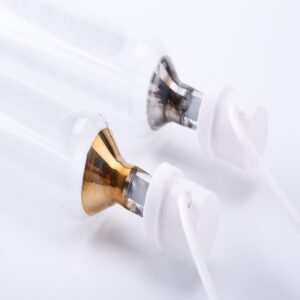
General causes of UV lamp failure
I. What is the reason for the fog in the UV lamp? If there is fog inside the tube, it is:
(1) There is a problem with the quartz tube, that is, the dehydroxylation is not good.
(2) Or the exhaust is not good during the production process.
(3) The purity of the gas is not enough.
If there is fog outside the tube, it is: the volatile gas of ink and varnish adheres to the tube wall. It can be wiped regularly with alcohol or other solvents.
II. The main reason for the deformation of the UV lamp, what are the adverse reactions after deformation?
The main reason for the deformation of the UV lamp is that the temperature is too high. Slight deformation does not affect normal use, but the life span will be greatly shortened. Severe deformation will cause the tube wall on one side of the lamp to become thinner and crack. Check whether the fan is damaged or the exhaust duct is too long, causing poor exhaust.
III. What is the reason for the crystal adsorption inside the UV lamp?
During the production of UV lamps, the quartz tube is not cleaned properly and has impurities.
IV. Why does the UV lamp deform into bubbles and burst?
This is caused by localized overheating or thinning of the quartz tube wall. Check the exhaust system for unobstructed operation.
5. Why does the metal tip of a UV lamp keep melting and burning?
a) The metal lamp holder has been used for a long time, and the copper frame has oxidized. This can cause poor contact in certain areas, resulting in excessive current and sparking, causing melting.
b) If a new lamp melts, it’s because the metal tip of the UV lamp and the lamp holder are in poor contact, causing sparking and melting. Check the copper contacts on the lamp holder for oxidation and the spring for elasticity.
6. Why does a UV lamp fail to ignite after a few hours of use (the lamp is otherwise intact)?
If it’s a metal halide lamp, it’s likely due to an improper halide ratio, low transformer output, or excessive lamp voltage. If it’s a mercury lamp, it could be due to an electrode problem, internal quality issues with the lamp, or a leak.
7. Why are the ends of a UV lamp black?
This is electrode powder flaking off and adhering to the tube wall, but it’s normal for the lamp to last for the lifespan. It’s not normal for this to occur after 100 to 200 hours.
8. What causes a UV lamp to suddenly crack during use?
a) Excessive current (such as a short circuit in the capacitor circuit)
b) Dirt hitting the tube wall during air intake.
c) Poor sealing of the electrodes (e.g., molybdenum and platinum).
9. Why does a UV lamp consistently experience voltage drops and won’t recover during use?
a) Excessive exhaust air
b) The cold-end electrode temperature doesn’t rise.
c) The electrical parameters of the transformer, capacitor, and lamp don’t match.
d) The network voltage is too low, causing the transformer output voltage to be too low.
10. Why does a UV lamp develop fingerprint-like patterns on the tube wall after 300-500 hours of use?
a) Touching the tube wall during installation can cause this.
b) If there are marks on the inside of the wall, it means the quartz tube wasn’t cleaned thoroughly enough during lamp production. 11. The current and voltage of the UV lamp are normal, but the light is abnormal, dim, and green-yellow. What is the reason?
(1) The power parameters of the lamp are incorrect.
(2) The lamp has a slow leak.
(3) The exhaust of the lamp was not clean during production.
(4) The transformer is too small.
12. Why does the UV lamp light up and shut down normally the first time, but never light up again?
If the capacitor and transformer are intact, the circuit is smooth, and there is no poor contact (voltage at both ends of the lamp), then the problem is with the lamp itself, usually a problem with the electrodes or a leak in the lamp.

anata
UV知识解答
UV failure
Related Articles